India’s manufacturing ecosystem has received a mixed signal from the latest TransUnion CIBIL-SIDBI MSME Pulse Report, which reveals that Manufacturing MSME Credit Growth has slowed to its weakest pace in three years. While the country’s MSME sector continues to remain one of the biggest contributors to employment, exports and GDP, formal credit availability for manufacturing businesses appears to be tightening.
The report indicates that lenders are increasingly shifting their focus towards trade and professional services, leaving many manufacturing MSMEs facing greater challenges in securing institutional finance. The trend raises concerns at a time when the Government of India continues to promote domestic manufacturing through initiatives such as Make in India, Production Linked Incentive (PLI) schemes and MSME development programmes.
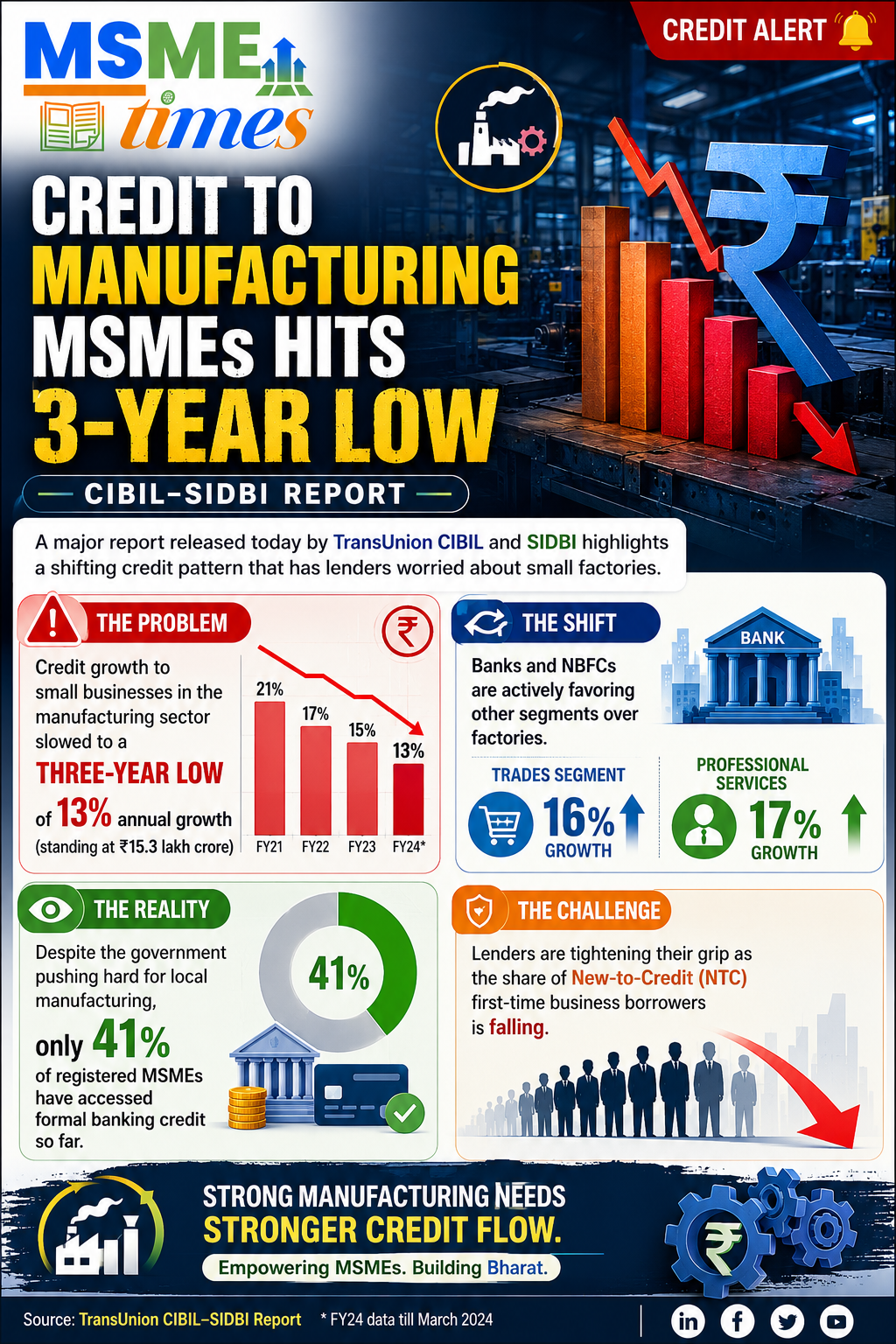
Manufacturing MSME Credit Growth Slows to 13%
According to the latest TransUnion CIBIL-SIDBI Report, outstanding credit to manufacturing MSMEs grew by only 13% year-on-year, reaching approximately ₹15.3 lakh crore. This represents the slowest annual growth witnessed by the manufacturing segment in the last three years.
Although the sector continues to receive significant lending support, the pace of credit expansion has moderated considerably compared to previous years. Industry experts believe rising credit risk, cautious lending practices and changing business priorities are contributing to the slowdown.
For thousands of small factories across India, easier access to affordable finance remains critical for purchasing machinery, expanding production capacity, upgrading technology and managing working capital requirements.
Banks and NBFCs Shift Lending Towards Trade and Services
One of the key findings of the report is the noticeable shift in lending preferences among banks and Non-Banking Financial Companies (NBFCs).
Instead of manufacturing businesses, lenders are increasingly extending credit to:
- Trade businesses, which recorded 16% annual credit growth
- Professional services, which registered 17% annual growth
This change indicates that financial institutions currently perceive service-oriented businesses as comparatively lower-risk or faster-growing opportunities.
While manufacturing requires higher capital investments and longer repayment cycles, trading and service businesses often generate quicker cash flows, making them relatively attractive from a lending perspective.
Formal Credit Still Out of Reach for Many MSMEs
The report also highlights another significant challenge for India’s MSME ecosystem.
Despite several government initiatives aimed at improving financial inclusion, only 41% of registered MSMEs have accessed formal institutional credit.
This means a majority of small enterprises still depend on:
- Personal savings
- Informal borrowing
- Friends and family
- Local money lenders
- Unsecured financing
Limited access to affordable formal finance restricts business expansion, technology adoption, productivity improvements and employment generation.
Decline in First-Time Business Borrowers
Another important trend identified in the report is the decline in New-to-Credit (NTC) borrowers.
NTC borrowers refer to entrepreneurs and small businesses accessing formal business loans for the very first time.
The falling share of first-time borrowers suggests lenders have become more selective while approving new business credit. Financial institutions are increasingly preferring businesses with established repayment histories over new enterprises.
This cautious lending environment could create additional challenges for startups and first-generation entrepreneurs seeking capital to establish manufacturing operations.
Implications for India’s Manufacturing Ambitions
The slowdown in Manufacturing MSME Credit Growth comes at a crucial stage for India’s industrial development strategy.
The Government has consistently emphasised strengthening domestic manufacturing through:
- Make in India
- Atmanirbhar Bharat
- Production Linked Incentive (PLI) schemes
- Digitalisation of MSMEs
- Export promotion initiatives
However, sustained industrial expansion depends not only on policy support but also on adequate availability of affordable credit.
Without sufficient access to institutional finance, many MSMEs may struggle to modernise production facilities, increase competitiveness or expand into global markets.
Why Manufacturing MSMEs Need Strong Credit Support
Manufacturing businesses generally require significantly higher investments compared to trading or service enterprises.
Credit enables manufacturers to:
- Purchase new machinery
- Upgrade technology
- Increase production capacity
- Hire skilled workers
- Manage inventory
- Improve product quality
- Expand exports
A slowdown in lending can therefore directly influence production growth, employment creation and overall industrial output.
Industry Outlook
Experts believe financial institutions may gradually rebalance their lending strategies if economic conditions remain stable and manufacturing demand continues to improve.
Greater adoption of digital lending, alternative credit assessment models and government-backed guarantee schemes could also improve credit accessibility for small manufacturers over the coming years.
Strengthening formal credit penetration remains essential for India’s long-term vision of becoming a global manufacturing hub.
Overall View
The latest TransUnion CIBIL-SIDBI MSME Pulse Report presents a cautious outlook for India’s manufacturing sector. While manufacturing MSMEs continue to play a vital role in the country’s economy, the slowdown in credit growth and declining participation of first-time borrowers indicate growing financing challenges. Policymakers, financial institutions and industry stakeholders will need to work together to ensure easier access to formal credit, enabling MSMEs to invest, innovate and compete in an increasingly dynamic global market.
Frequently Asked Questions (FAQs)
What is the latest Manufacturing MSME Credit Growth rate?
According to the latest TransUnion CIBIL-SIDBI Report, Manufacturing MSME Credit Growth stood at 13% year-on-year, the slowest in three years.
How much outstanding credit do manufacturing MSMEs currently hold?
Outstanding manufacturing MSME credit reached approximately ₹15.3 lakh crore.
Which sectors are receiving more lending than manufacturing?
Banks and NBFCs are currently favouring trade (16%) and professional services (17%) over manufacturing businesses.
How many registered MSMEs have accessed formal credit?
Only 41% of registered MSMEs have accessed formal institutional banking credit.