India-New Zealand FTA Expected by Late October: 100% Duty-Free Access for Indian Exports
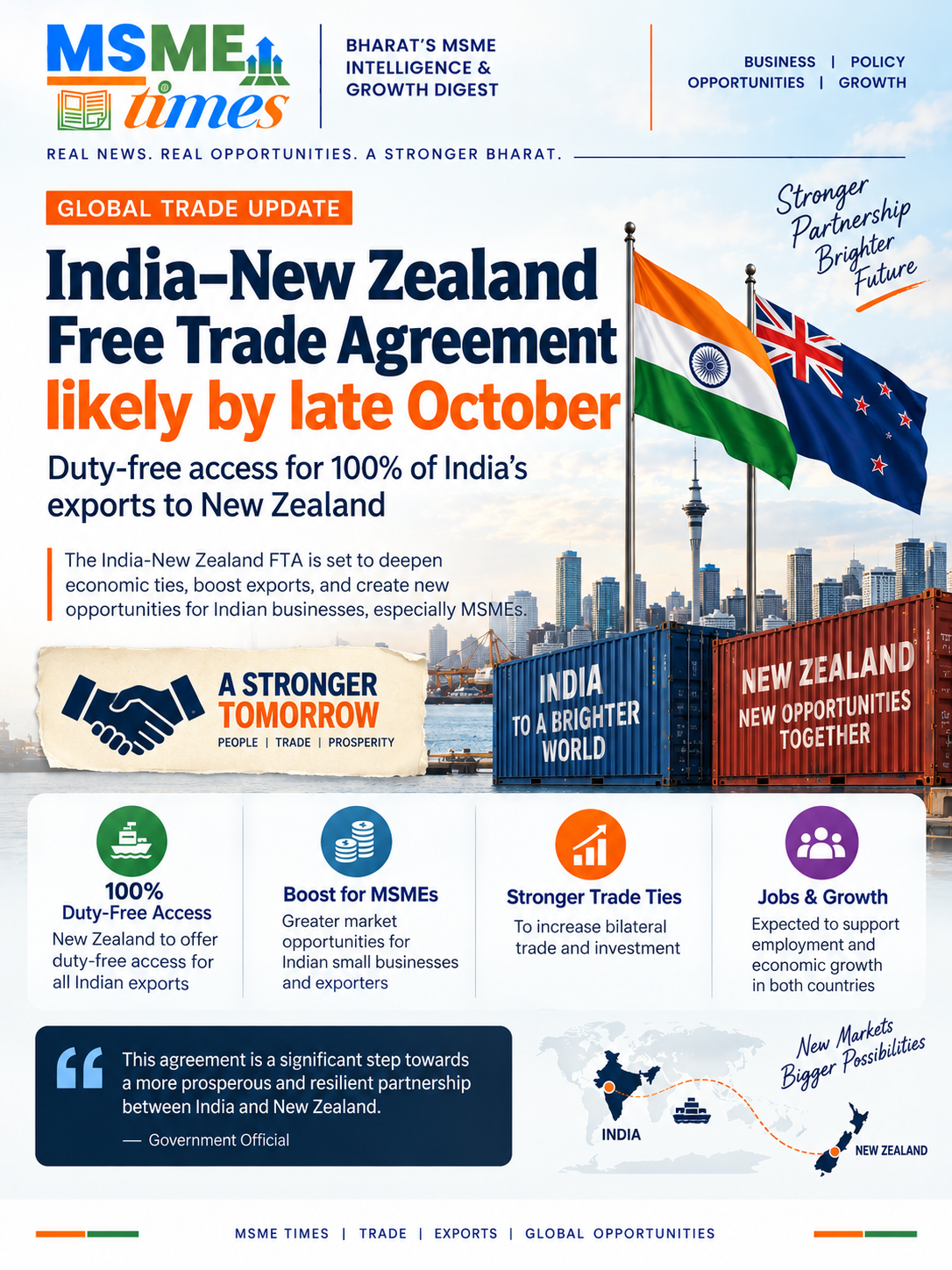
The India-New Zealand Free Trade Agreement (FTA) is expected to become operational in the latter half of October 2026, opening a new phase in trade and investment relations between the two countries.
Commerce Secretary Rajesh Agrawal said the agreement is expected to be operationalised in the second half of October, while an official indicated that October 19 is the expected date. The exact implementation date is still subject to completion of the required operational processes and procedures.
The agreement was signed by India and New Zealand on April 27, 2026, after negotiations concluded in December 2025.
India New Zealand FTA 2026: Key Highlights
The agreement includes several important provisions:
- 100% duty-free access for Indian exports to New Zealand
- $20 billion New Zealand investment commitment over 15 years
- Greater market access for Indian MSMEs
- Opportunities in textiles, leather, footwear and engineering
- Benefits for processed food and other export sectors
- Services market access across 118 sectors/sub-sectors
- Protection for several sensitive Indian agricultural and dairy products
100% Duty-Free Access for Indian Exports
One of the biggest features of the India-New Zealand FTA is the commitment by New Zealand to provide zero-duty market access for 100% of Indian exports from the agreement’s entry into force.
This covers all tariff lines for India’s exports to New Zealand.
For Indian exporters, this can improve price competitiveness in the New Zealand market.
Products that previously faced tariffs will be able to enter under the new duty-free framework once the agreement becomes operational.
Which Indian Sectors Could Benefit?
The agreement is particularly relevant for labour-intensive and manufacturing sectors.
Government documents identify opportunities across:
- Textiles
- Apparel
- Leather
- Footwear
- Engineering goods
- Processed foods
- Pharmaceuticals
- Chemicals
- Electronics
- Agricultural products
For Indian MSMEs, these sectors are particularly important because many smaller businesses participate in domestic and international supply chains.
What Does Duty-Free Access Mean for MSMEs?
Tariffs can increase the landed cost of exported products.
When tariffs are eliminated, exporters may have more flexibility in pricing their products or improving margins, depending on competition and other costs.
For MSMEs, this could help in:
- Entering new markets
- Finding new international buyers
- Expanding production
- Building export-oriented capacity
- Participating in global supply chains
- Increasing international competitiveness
However, duty-free access does not remove other export requirements such as product standards, documentation, packaging, logistics and certifications.
New Zealand Commits $20 Billion Investment
The FTA also includes a significant investment commitment.
New Zealand has committed to invest $20 billion in India over 15 years.
The commitment is expected to strengthen long-term economic cooperation between the two countries.
Potential areas of cooperation include manufacturing, infrastructure, technology, agriculture, startups and other sectors.
For Indian businesses, greater foreign investment can potentially create opportunities through partnerships, supply chains and technology collaboration.
India Has Protected Sensitive Sectors
While the agreement provides extensive access for Indian exports, India has also maintained protection for several sensitive sectors.
The government has kept products such as dairy and several agricultural items outside tariff concessions. These include milk, cream, whey, yoghurt and cheese, as well as products such as onions, chana, peas, corn and almonds.
This reflects the government’s approach of expanding export opportunities while protecting sensitive domestic sectors.
Services Sector Also Gets Market Access
The India-New Zealand FTA is not limited to goods.
The agreement provides market access to India across 118 services sectors/sub-sectors, along with MFN treatment across 139 sectors/sub-sectors.
This could create opportunities for Indian professionals and service businesses in areas such as technology, professional services, education and other sectors.
Opportunities for Indian Professionals
The agreement also includes provisions related to student mobility and professional opportunities.
Government documents say STEM graduates can receive post-study work opportunities of up to three years, while doctoral graduates can receive up to four years.
The agreement also includes a pathway related to skilled professionals covering 5,000 occupations.
These provisions can strengthen the services and talent dimension of India-New Zealand economic relations.
Manufacturing Inputs Could Become Cheaper
The agreement also provides India with duty-free access to certain manufacturing inputs.
These include:
- Wooden logs
- Coking coal
- Metal waste and scraps
The government says such access can help lower input costs and improve the competitiveness of Indian manufacturing.
This can be relevant for manufacturers that depend on imported inputs as part of their production process.
Why the FTA Matters for Indian Exports
New Zealand currently maintains tariffs of up to 10% on some Indian products, including ceramics, carpets, automobiles and auto components.
Removing these tariffs can change the competitive position of Indian exporters.
For example, an Indian manufacturer competing with suppliers from countries that already have preferential access could potentially gain a more level playing field once the FTA becomes operational.
Export Opportunities for Textile and Leather MSMEs
Textiles, apparel, leather and footwear are among the sectors specifically highlighted by the Indian government.
These industries are heavily dependent on MSMEs and labour-intensive manufacturing.
Greater market access can help exporters target New Zealand buyers with a more competitive landed price.
However, businesses will still need to meet New Zealand’s product standards and buyer requirements.
Engineering Goods Could Also Gain
Engineering goods are another important area.
Indian engineering MSMEs already supply machinery, components, fabricated products and industrial equipment to international markets.
The elimination of tariffs can provide an additional opportunity for these businesses to explore New Zealand customers.
Companies will need to focus on product quality, certifications, delivery reliability and after-sales service to convert tariff benefits into actual orders.
What Should Indian MSMEs Do Before the FTA Starts?
Businesses should begin preparing before the agreement becomes operational.
1. Identify Relevant Products
Exporters should identify which of their products qualify for duty-free access.
2. Check HS Codes
Correct classification under the Harmonised System is essential for determining applicable tariff treatment.
3. Understand Rules of Origin
Businesses need to understand the agreement’s origin requirements before claiming preferential treatment.
4. Research New Zealand Buyers
Exporters should identify distributors, importers, wholesalers and institutional buyers.
5. Review Pricing
Companies should calculate how tariff elimination could affect landed costs and pricing.
6. Strengthen Compliance
Product standards, certifications, packaging and documentation remain important even when tariffs are removed.
FTA Does Not Guarantee Higher Exports
It is important to understand that an FTA creates market access—it does not automatically create export orders.
Indian businesses will still compete on:
- Quality
- Price
- Delivery
- Product design
- Certifications
- Branding
- Customer service
- Logistics
Therefore, MSMEs need to combine the tariff advantage with a strong export strategy.
India-New Zealand Trade Relations Enter a New Phase
The FTA is part of India’s wider strategy of building trade partnerships with developed markets.
The agreement provides Indian exporters with access to a relatively high-income market while creating opportunities for investment and services.
New Zealand will also receive preferential access to the Indian market for a significant share of its exports over time.
The result is intended to be a broader and deeper economic relationship between the two countries.
When Will the India-New Zealand FTA Start?
The Commerce Secretary has said the agreement is expected to be operationalised in the latter half of October 2026, with the exact date to be announced after both sides complete the necessary procedures.
An official has indicated October 19 as the expected date.
Therefore, for publication purposes, it is more accurate to use “expected by late October” rather than presenting October 19 as an already-finalised implementation date.
Conclusion
The India New Zealand FTA 2026 could create significant opportunities for Indian exporters and MSMEs.
The agreement provides 100% duty-free access for Indian exports to New Zealand, while New Zealand has committed $20 billion in investment over 15 years.
Textiles, leather, footwear, engineering goods, processed foods, pharmaceuticals, chemicals and electronics are among the sectors that could benefit from improved market access.
The agreement is expected to become operational in the latter half of October, with October 19 currently indicated as the expected date, subject to completion of the required procedures.
For Indian MSMEs, the next step is to convert this new market access into actual business opportunities through better product quality, international compliance, buyer discovery and competitive pricing.
FAQs
When will the India-New Zealand FTA come into force?
The agreement is expected to become operational in the latter half of October 2026. October 19 has been indicated as the expected date, but the final date remains subject to completion of implementation procedures.
Will all Indian exports get duty-free access to New Zealand?
The agreement provides duty-free access for 100% of India’s exports to New Zealand from entry into force.
How much will New Zealand invest in India?
New Zealand has committed to $20 billion of investment over 15 years.
Which Indian sectors can benefit from the FTA?
Textiles, apparel, leather, footwear, engineering goods, processed foods, pharmaceuticals, chemicals and electronics are among the sectors expected to benefit.
Are Indian dairy products fully open under the FTA?
No. India has protected several sensitive dairy and agricultural products from tariff concessions.