
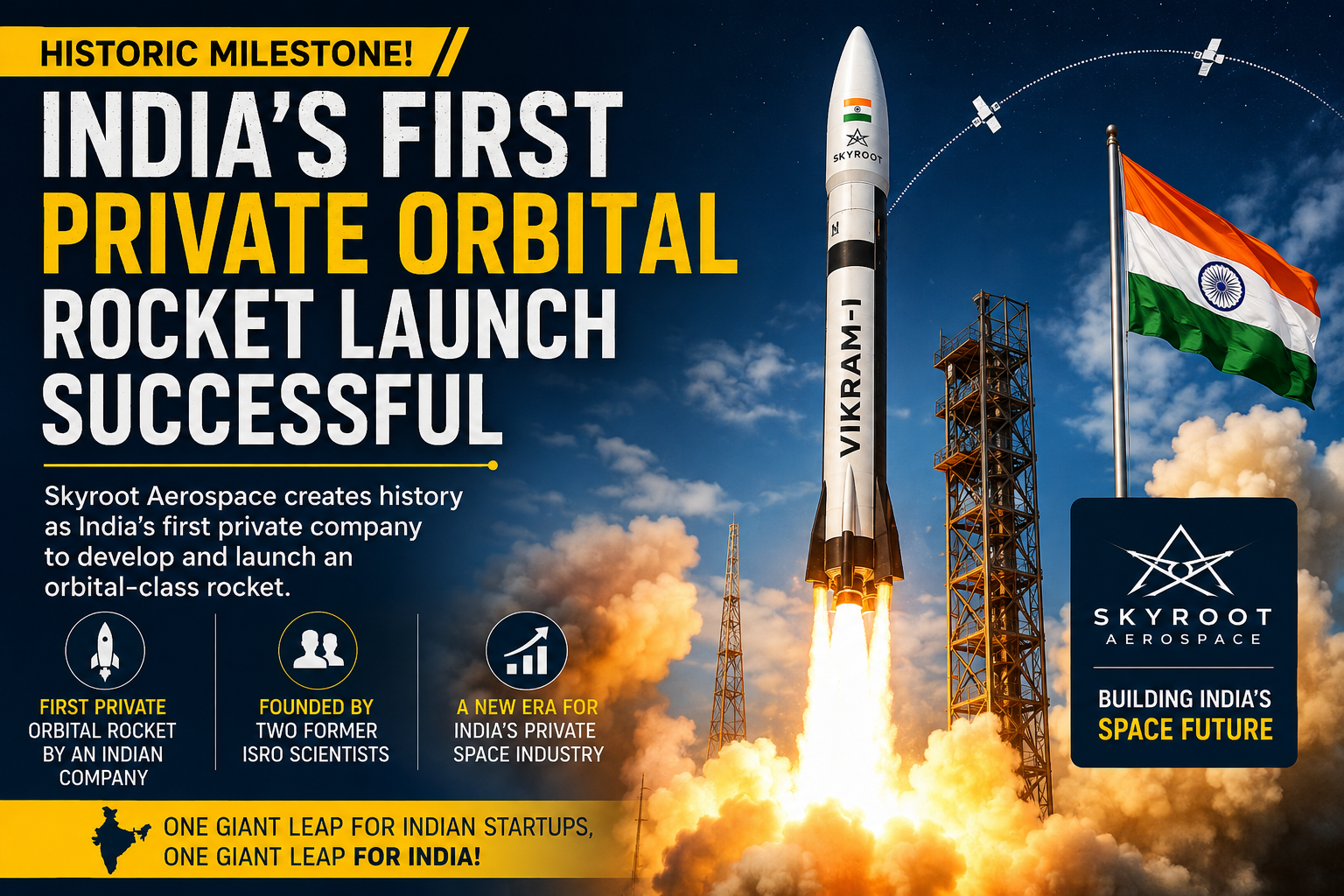
India First Private Orbital Rocket has marked a historic milestone for the country’s growing private space ecosystem. Hyderabad-based Skyroot Aerospace, founded by two former ISRO scientists, successfully launched the nation’s first privately developed orbital rocket, showcasing India’s rapidly expanding capabilities in commercial space technology.
The achievement is considered a major breakthrough for India’s space sector, demonstrating how private startups are now contributing alongside government agencies in advancing space exploration and satellite launch capabilities. The successful mission also reflects the positive impact of recent policy reforms that have opened the Indian space industry to private participation.
India First Private Orbital Rocket Marks a Historic Achievement
The successful launch of the India First Private Orbital Rocket represents a new chapter in the country’s aerospace journey. For decades, orbital launch missions were led primarily by the Indian Space Research Organisation (ISRO). However, the emergence of private companies like Skyroot Aerospace is transforming India’s commercial space landscape.
This achievement highlights the growing strength of Indian startups in developing advanced aerospace technologies capable of serving both domestic and international markets.
Skyroot Aerospace: From ISRO Engineers to Space Entrepreneurs
Skyroot Aerospace was established by two former ISRO scientists who envisioned making space launches more affordable, accessible, and efficient.
Their experience in India’s national space program helped the company develop innovative launch vehicle technology capable of supporting commercial satellite deployment. The successful launch demonstrates how Indian startups are increasingly competing in the global space economy through innovation and engineering excellence.
Today, Skyroot Aerospace is regarded as one of India’s leading private space technology companies.
Boost for India’s Commercial Space Industry
The launch of the India First Private Orbital Rocket is expected to strengthen India’s position in the rapidly growing global space market.
Private companies are now playing an important role in:
- Satellite launch services
- Commercial space missions
- Aerospace innovation
- Space technology research
- Small satellite deployment
- International launch partnerships
Experts believe the success of private launch providers will encourage further investment into India’s space startup ecosystem.
Government Reforms Encouraging Private Participation
In recent years, the Government of India has introduced several reforms to promote private participation in the space sector. Organizations such as IN-SPACe have enabled startups to access infrastructure, testing facilities, and launch opportunities previously reserved for government agencies.
These policy changes have created a favorable environment for innovation, allowing Indian companies to develop globally competitive space technologies.
The successful India First Private Orbital Rocket mission reflects the positive outcomes of these reforms.
What This Means for India’s Startup Ecosystem
The launch is more than just a technological achievement—it is also a major milestone for India’s startup ecosystem.
It demonstrates that Indian startups can successfully develop high-end engineering solutions in sectors traditionally dominated by government organizations. The achievement is expected to inspire greater investment in deep-tech startups working in aerospace, robotics, artificial intelligence, and advanced manufacturing.
Industry experts believe private space companies will play a vital role in creating high-skilled employment opportunities while strengthening India’s position in the global innovation ecosystem.
Future Outlook
With the successful launch of the India First Private Orbital Rocket, India is entering a new era of commercial space exploration.
As demand for satellite launches continues to grow worldwide, private Indian companies are expected to play an increasingly significant role in providing reliable and cost-effective launch services.
Skyroot Aerospace’s success is likely to encourage more entrepreneurs and investors to enter the country’s expanding space technology sector.
Conclusion
The successful launch of the India First Private Orbital Rocket by Skyroot Aerospace represents a landmark achievement for India’s private aerospace industry. Founded by two former ISRO scientists, the company has demonstrated that Indian startups possess the capability to compete globally in advanced space technology.
The mission not only strengthens India’s commercial space ambitions but also highlights the country’s growing leadership in innovation, entrepreneurship, and deep-tech development.
Frequently Asked Questions
What is the India First Private Orbital Rocket?
It is the first privately developed orbital rocket successfully launched by Skyroot Aerospace, marking a milestone for India’s private space sector.
Who founded Skyroot Aerospace?
Skyroot Aerospace was founded by two former ISRO scientists with the vision of building affordable commercial launch vehicles.
Why is this launch important?
The launch strengthens India’s commercial space industry, encourages private innovation, and positions Indian startups as global players in aerospace technology.
Suggested Internal Link
Read More: Latest Startup & Innovation News on MSME Times
Suggested External Link
Official Source: Skyroot Aerospace / IN-SPACe / ISRO
The successful launch of India’s first private orbital rocket is expected to inspire a new generation of entrepreneurs, engineers, and innovators to invest in cutting-edge space technologies. As private participation in the aerospace sector continues to grow, India is well-positioned to become a global hub for affordable satellite launches, advanced space research, and commercial space missions. Skyroot Aerospace’s achievement not only strengthens the nation’s space ambitions but also reinforces the vision of an innovation-driven and self-reliant Bharat. With continued government support and increasing private investment, the country’s space startup ecosystem is poised for significant growth in the years ahead.
Source: