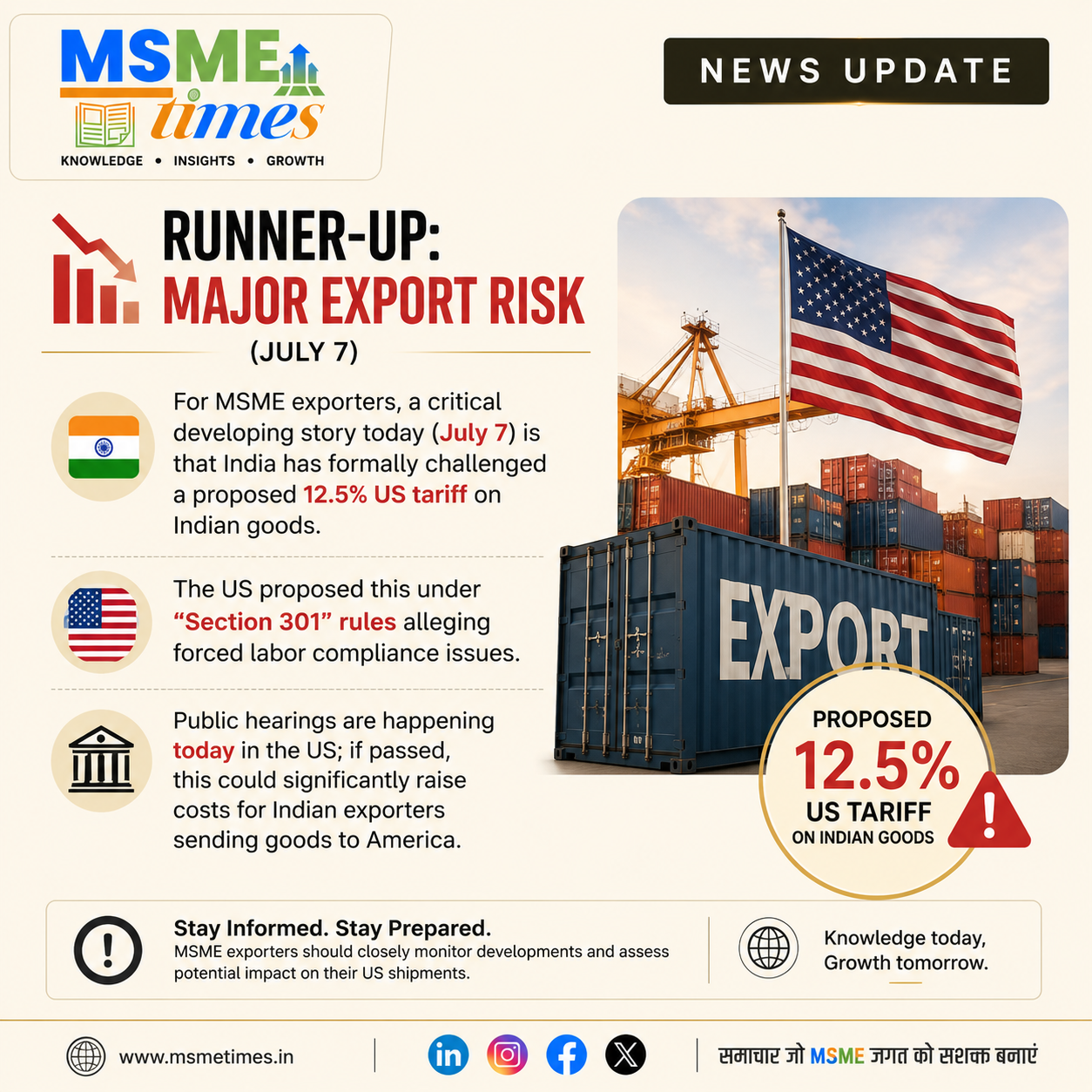
12.5% US Tariff on Indian Goods has emerged as one of the most significant trade developments for Indian exporters. The proposed tariff, currently under consideration by US authorities, has raised concerns among exporters, trade associations, and policymakers because it could increase the cost of Indian products entering the American market.
India has formally challenged the proposal and is defending its position through the appropriate trade consultation process. For thousands of Micro, Small and Medium Enterprises (MSMEs) that depend on exports to the United States, the outcome of this dispute could influence pricing, competitiveness, and future business opportunities.
The United States remains one of India’s largest export destinations. Engineering goods, textiles, garments, leather products, pharmaceuticals, chemicals, handicrafts, machinery, automotive components, and processed food are among the sectors that contribute significantly to India’s exports. A higher import duty on these products may affect both exporters and overseas buyers.
Why the Proposed Tariff Matters
The proposed 12.5% US Tariff on Indian Goods is important because tariffs directly increase the landed cost of imported products.
When import duties rise, American buyers may either absorb the higher cost or ask Indian suppliers to reduce prices. In many cases, exporters are forced to lower their profit margins to remain competitive.
For large corporations this may be manageable, but for MSMEs operating on limited margins, even a small increase in export costs can have a significant financial impact.
If implemented, the tariff could influence purchasing decisions by US importers and encourage them to explore alternative suppliers from countries where similar duties are not applicable.
What is Section 301?
The proposed measure is linked to Section 301 of US trade law, which allows the United States to investigate and respond to trade practices it considers unfair or inconsistent with its policies.
In this case, the proposed tariff has reportedly been associated with concerns regarding forced labour compliance in supply chains. Public consultations and hearings are part of the process before any final decision is taken.
It is important to note that such proposals do not automatically become law. They go through review, consultation, and legal examination before implementation.
India’s Response to the Proposed Tariff
India has officially challenged the proposal and is actively presenting its position before the relevant US authorities.
Government officials have argued that Indian industries comply with applicable laws and that any trade restrictions should be based on transparent evidence and internationally accepted trade practices.
Trade experts believe that India’s participation in the consultation process reflects its commitment to protecting exporters while maintaining healthy bilateral trade relations with the United States.
The final decision will depend on the outcome of the review process and the evidence presented by all stakeholders.
How MSME Exporters Could Be Affected
If the 12.5% US Tariff on Indian Goods is implemented, MSMEs may experience several challenges.
Higher Export Costs
Additional import duties can reduce price competitiveness in the US market.
Lower Profit Margins
Exporters may need to absorb part of the increased cost to retain overseas customers.
Reduced Demand
Higher product prices could encourage buyers to shift towards suppliers from competing countries.
Pressure on Manufacturing
Lower export orders may affect production schedules, employment, and investment plans, particularly in export-oriented industries.
Supply Chain Adjustments
Businesses may need to diversify export markets and strengthen compliance documentation to meet international buyer expectations.
Industries That Could Face the Biggest Impact
Several export-oriented industries could closely monitor developments.
These include:
- Engineering Goods
- Auto Components
- Textiles and Garments
- Leather Products
- Handicrafts
- Chemicals
- Pharmaceuticals
- Industrial Machinery
- Precision Manufacturing
- Processed Food Products
Many MSMEs operating in these sectors depend heavily on the US market for a substantial portion of their annual revenue.
Expert Analysis
Trade analysts believe that while the proposal has created uncertainty, it is still undergoing the review process.
Experts suggest that Indian exporters should avoid making immediate business decisions solely based on the proposal. Instead, businesses should monitor official announcements, maintain strong compliance records, and explore new international markets to reduce dependence on a single export destination.
Many economists also point out that India and the United States share a strong trade relationship, making constructive dialogue the preferred path for resolving such disputes.
What MSME Exporters Should Do
Exporters should closely monitor official announcements from both governments and maintain regular communication with overseas buyers.
Businesses can also:
- Review export contracts carefully.
- Diversify export destinations.
- Strengthen supply chain documentation.
- Ensure compliance with international labour and environmental standards.
- Consult export promotion councils regarding evolving trade regulations.
- Explore government export assistance schemes to manage risks.
A proactive approach can help businesses reduce uncertainty and maintain long-term competitiveness.
Overall View
The proposed 12.5% US Tariff on Indian Goods highlights the growing importance of global trade compliance and market diversification. Although the tariff has not been finalized, it serves as a reminder that international trade policies can significantly influence MSME exports.
India’s challenge demonstrates the government’s intention to protect domestic exporters and maintain fair market access. For MSMEs, staying informed, improving compliance, and expanding into new export markets will be key strategies for navigating evolving global trade conditions.
Conclusion
The proposed tariff remains under review, and its final outcome will determine the extent of its impact on Indian exporters. While concerns remain, businesses should focus on preparedness rather than panic. Strong documentation, diversified markets, and continuous monitoring of official developments can help MSMEs remain resilient in an increasingly competitive global trade environment.
Frequently Asked Questions
What is the proposed 12.5% US tariff?
It is a proposed import duty that could apply to selected Indian goods entering the US market after the review process.
Will all Indian exports be affected?
No. The final scope depends on the outcome of the review and the products covered by any final decision.
Why has India challenged the proposal?
India believes its exporters should not face unjustified trade restrictions and has presented its position during the consultation process.
How can MSMEs prepare?
Businesses should monitor official updates, strengthen compliance, diversify export markets, and maintain close communication with overseas buyers.
Internal Links (Add After Publishing)
- Latest MSME Export News
- Government Schemes for Exporters
- DGFT Policy Updates
- India-US Trade News
- MSME Finance & Working Capital
External DoFollow Links
- Ministry of Commerce & Industry
- DGFT
- Export Promotion Councils
- Office of the United States Trade Representative (USTR)