
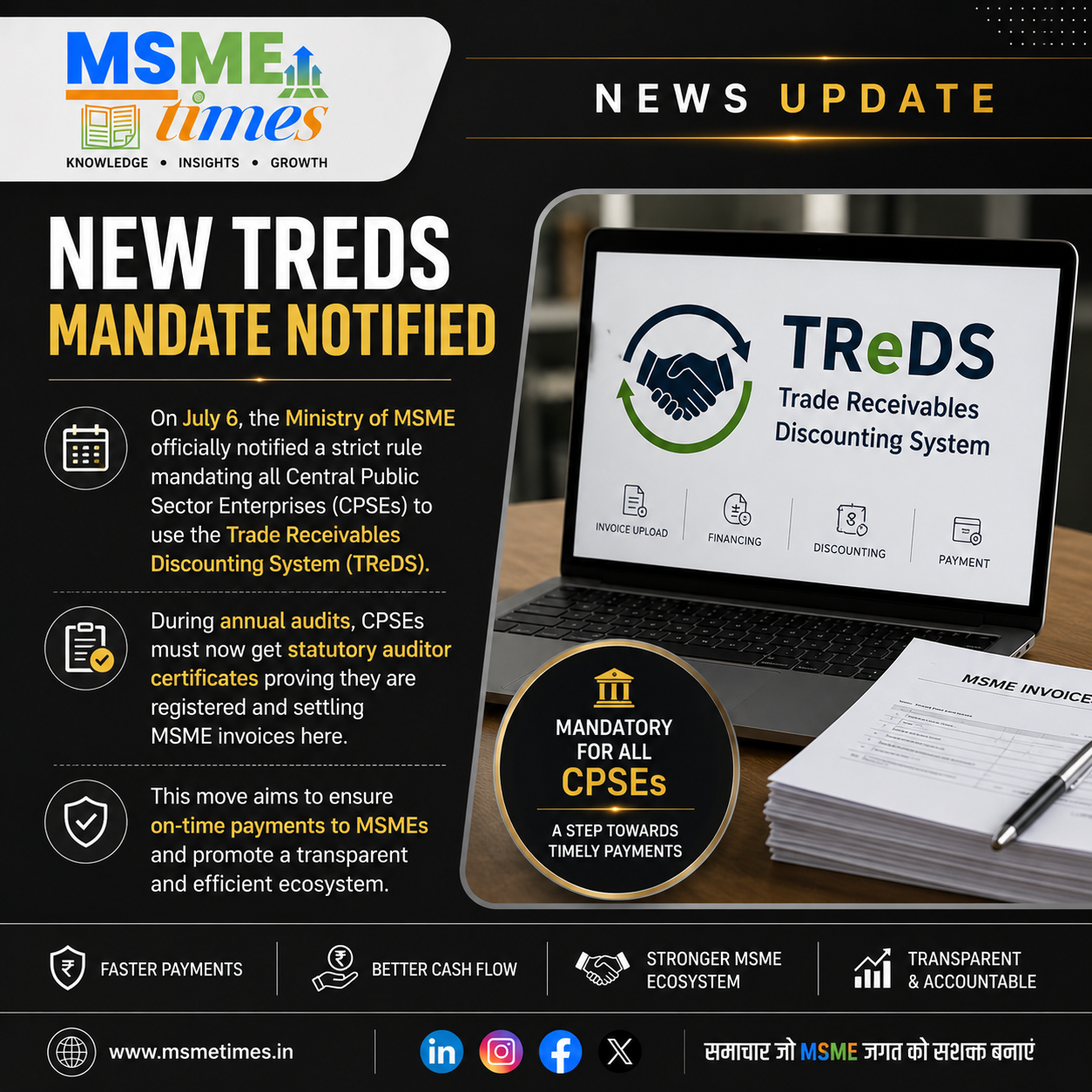
Delayed payments have long been one of the biggest challenges faced by India’s Micro, Small and Medium Enterprises (MSMEs). In a significant policy decision, the Ministry of MSME has officially notified TReDS Mandatory for CPSEs, making it compulsory for all Central Public Sector Enterprises (CPSEs) to register on the Trade Receivables Discounting System (TReDS) and comply with new audit requirements. The notification, issued on July 6, is expected to strengthen payment discipline, improve transparency, and provide faster access to working capital for MSMEs across the country.
Table of Contents
- What is TReDS?
- Why TReDS Mandatory for CPSEs?
- What Does the New Notification Say?
- How Will MSMEs Benefit?
- Role of Statutory Auditors
- Impact on Public Sector Enterprises
- Expert Opinion
- Overall View
- Frequently Asked Questions
What is TReDS?
The Trade Receivables Discounting System (TReDS) is an RBI-regulated digital platform that enables MSMEs to receive early payment against invoices raised on large buyers, including government departments and corporate entities.
Instead of waiting for payment after the credit period, MSMEs can upload approved invoices on the TReDS platform. Banks and financial institutions then finance these invoices, allowing businesses to receive funds much earlier. This improves cash flow, reduces dependence on costly loans, and supports business expansion.
Why is TReDS Mandatory for CPSEs?
The government’s decision to make TReDS Mandatory for CPSEs comes after years of concerns regarding delayed payments to MSMEs.
Thousands of small businesses supplying products and services to government-owned companies often face payment delays extending beyond the prescribed timelines. Such delays affect working capital, production planning, employee salaries, and overall business sustainability.
By making TReDS mandatory, the government aims to ensure that invoices are processed through a transparent digital platform, reducing payment bottlenecks and improving accountability.
What Does the New Notification Say?
According to the notification issued by the Ministry of MSME, every Central Public Sector Enterprise (CPSE) must now:
- Register on an approved TReDS platform.
- Process eligible MSME invoices through TReDS.
- Obtain a Statutory Auditor Certificate during annual audits confirming compliance.
- Demonstrate that eligible MSME invoices are being settled through the platform.
The notification introduces an additional compliance mechanism by linking TReDS implementation with the annual audit process. This is expected to encourage greater adherence among CPSEs and reduce the scope for delayed payments.
How Will MSMEs Benefit from TReDS Mandatory for CPSEs?
The new mandate is expected to provide several benefits for India’s MSME sector.
Faster Payments
Instead of waiting several weeks or months, MSMEs can receive funds shortly after invoice acceptance through financing institutions available on TReDS.
Better Cash Flow
Improved liquidity allows businesses to purchase raw materials, pay suppliers, manage salaries, and accept larger orders without financial stress.
Reduced Borrowing Costs
Businesses may rely less on expensive working capital loans as invoice discounting becomes more accessible.
Improved Financial Planning
Predictable payment cycles enable MSMEs to manage operations more efficiently and invest in future growth opportunities.
Role of Statutory Auditors
One of the most important aspects of the notification is the requirement for Statutory Auditor Certification.
During annual audits, auditors must certify whether the CPSE has complied with the TReDS mandate. This additional reporting requirement introduces greater transparency and strengthens monitoring by the government.
Experts believe that integrating TReDS compliance into the audit process will significantly improve implementation compared to previous advisory-based approaches.
Impact on Central Public Sector Enterprises
For CPSEs, the new compliance requirements will require stronger invoice management systems and timely approval of supplier invoices.
Many public sector companies may need to strengthen digital processes, coordinate with finance departments, and ensure that eligible MSME invoices are routed through approved TReDS platforms.
Although this may initially increase administrative responsibilities, the long-term benefits include better supplier relationships, improved transparency, and stronger compliance with government policies.
Industry Experts Welcome the Move
Industry stakeholders have largely welcomed the notification, describing it as an important step towards improving the MSME payment ecosystem.
Financial experts believe wider adoption of TReDS can significantly reduce payment delays, improve credit availability, and promote digital financial inclusion.
The mandate is also expected to encourage greater participation by banks and financial institutions, increasing competition in invoice financing and benefiting MSMEs through improved financing options.
Overall View
The decision to make TReDS Mandatory for CPSEs represents a major policy reform aimed at addressing one of the biggest structural challenges faced by MSMEs—delayed payments.
If implemented effectively, the new compliance framework can improve liquidity, strengthen business confidence, reduce working capital shortages, and support sustainable growth across India’s MSME sector.
Conclusion
The Ministry of MSME’s latest notification marks another important step in the government’s efforts to create a transparent and technology-driven payment ecosystem. Making TReDS Mandatory for CPSEs is expected to improve payment discipline, strengthen accountability through statutory audits, and ensure that MSMEs receive their dues more efficiently.
For thousands of small businesses supplying goods and services to government-owned enterprises, this initiative could significantly improve cash flow and reduce financial stress, ultimately contributing to a stronger MSME ecosystem and faster economic growth.
Frequently Asked Questions (FAQ)
What is TReDS?
TReDS is an RBI-regulated digital platform that enables MSMEs to receive early payment against invoices through banks and financial institutions.
Who must comply with the new TReDS notification?
All Central Public Sector Enterprises (CPSEs) are required to register and comply with the TReDS mandate.
Why has TReDS Mandatory for CPSEs been introduced?
The government aims to reduce delayed payments, improve transparency, and ensure faster payments for MSMEs.
Will this benefit MSMEs?
Yes. Faster invoice settlement improves cash flow, reduces borrowing costs, and strengthens working capital management.
Suggested Internal Links
- MSME Latest News
- Government Schemes for MSMEs
- Understanding Udyam Registration
- MSME Payment Rules Explained
External DoFollow Links
- Ministry of MSME – https://msme.gov.in
- Reserve Bank of India – https://rbi.org.in
- TReDS Information – https://www.invoicemart.com